Showing posts with label erosion. Show all posts

Thursday, September 25, 2008

Watch Out Richard Gere! There's Erosion in Rodanthe!

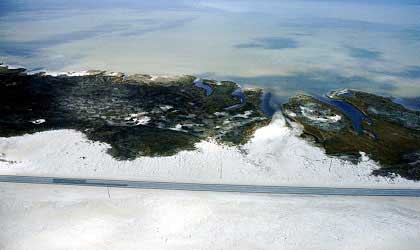
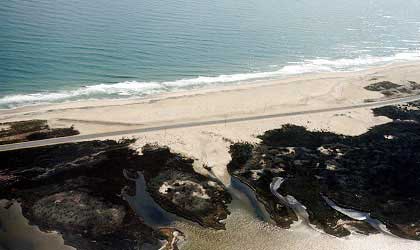
Highway 12, the primary roadway on North Carolina's Outer Banks, has experienced significant overwash over the years. Today we have additional photos of overwash on Hwy 12.
(HT: Ahab's Journal)

A shot of Rodanthe:


A shot of the S-Curves

This section of the Outer Banks, which is adjacent to the Pea Island National Wildlife Refuge, is highly susceptible to erosion. In this location, the highway acts as static infrastructure in an otherwise migrating barrier island. Here are some other pictures depicting island overwash and migration from the Outer Banks Task Force:


Wednesday, July 23, 2008

St Pete Beach to Renourish

Yesterday, I wrote a post* discussing the fate of T-Groins in St Pete Beach. The St Pete Beach City Commission has decided to remove the T-Groins and go ahead with a beach renourishment project.

The commission decided to go forward with a beach renourishment project in 2009 and recover the T-groins.

In 2010, they'll hire an engineer to look at alternative plans for the area, such as a possible artificial reef.

Council members will then begin implementing those changes by 2012.


* I originally stated that this decision was being made by the county commissioners. This was incorrect. The decision was made by the St Pete Beach City Commission.

Tuesday, July 22, 2008

Hardening St Pete Beach


Between Upham Beach to the St. Pete Beach, coastal managers have been trying to address beach erosion using temporary T-Groins. Now City Commissioners of St Pete Beach are debating whether to replace existing sandbags with a more permanent structure (i.e. rocks). From baynews9.com:

The tubes are temporary to test out the size and T-shape. If approved by city commissioners, the county wants to replace the bags with rocks.

Pinellas County Coastal Coordinator Nicole Elko said during the two-year study 50 percent of the sand has eroded, without the tubes it would have been 80 percent.

The current project cost $1.5 million and is funded by the county and state.

Elko said the tubes would save millions of dollars down the road. It costs $6 million to pump in more sand and restore the beach. The bags cut that in half at $3 million.


Below is a jpeg I made using Google Earth showing these T-Groins.


Notice the convex shape of the beach around the groins. You can also see a jetty to the left of the first T-Groin. All these structures impact longshore transport of sand.

Tuesday, June 17, 2008

Erosion on South Nags Head

In recent years, federal funding for beach renourishment projects have shrunk considerably. In the short term, residents can apply to put out sandbags; however, these sandbags can only represent temporary relief. One area experiencing significant erosion is South Nags Head NC.

From the Virginia-Pilot

To the despair of a number of homeowners, the state Division of Coastal Management set a deadline of May 1, 2008, to start removal of unvegetated sandbags from the rapidly eroding stretch of beach north of Oregon Inlet.

"I think that people are between a rock and a hard place," said Ellen Dutkowsky, who lives off Old Oregon Inlet Road in South Nags Head.

Beach nourishment projects proposed by the federal and town governments have not been funded so far, she said, but the shoreline continues to narrow. Dutkowsky said that her property is not sandbagged, but she fears for the future unless the beach is widened.

Tuesday, June 3, 2008

Living Shorelines

NOAA will be funding shoreline restoration in Alabama's Mobile Bay using Living Shorelines rather than traditional hardened shorelines.
In the past, shorelines were typically stabilized with hardened structures, such as bulkheads and seawalls, to prevent or minimize coastal erosion. However, scientists have found that these structures can actually increase the rate of coastal degradation. Waves reflect off the hardened structures, scouring the area in front of the wall and causing additional shoreline erosion. Bulkheads and seawalls also block tidal water flow to coastal wetlands, as well as hamper natural flood control, water treatment potential, and access for juvenile fish to their nursery habitat.

For those interested, VIMS Center for Coastal Resources Management has a site dedicated to living shorelines. The National Research Council also has an book titled "Mitigating Shore Erosion along Sheltered Coasts". Living shorelines can provide numerous ecosystem services including nursery habitat, nutrient and sediment filtering, and mitigation of erosion.

Coastal shorelines have exhibited chronic degradation, in that land use patterns have slowly changed over time. Because these changes impact the system as a whole, it makes sense to promote shoreline stabilization strategies which will reduce water pollution and promote nursery areas.

Craig Landry and I have a survey paper discussing the use of hedonic property models to measure property owners' willingness-to-pay for risk reduction and amenities in coastal zones. The paper focuses on ways hedonic property models can be applied to living shorelines.