Showing posts with label coastal development. Show all posts

Thursday, September 25, 2008

Watch Out Richard Gere! There's Erosion in Rodanthe!

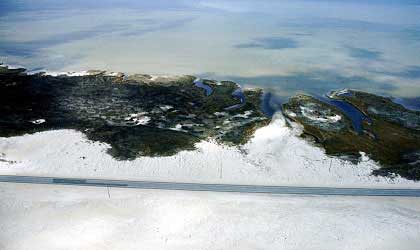
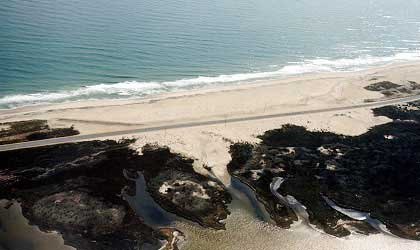
Highway 12, the primary roadway on North Carolina's Outer Banks, has experienced significant overwash over the years. Today we have additional photos of overwash on Hwy 12.
(HT: Ahab's Journal)

A shot of Rodanthe:


A shot of the S-Curves

This section of the Outer Banks, which is adjacent to the Pea Island National Wildlife Refuge, is highly susceptible to erosion. In this location, the highway acts as static infrastructure in an otherwise migrating barrier island. Here are some other pictures depicting island overwash and migration from the Outer Banks Task Force:


Sunday, June 8, 2008

Objections to Storm Water Rules

North Carolina is getting ready to implement new storm water rules. These rules have received numerous objections. From the Virginia Pilot

Coastal storm-water rules were first adopted in the state about 20 years ago. In 2005, the state Division of Water Quality determined that 90 percent of shellfish water closures were caused by storm-water runoff and that the rules needed to be updated to protect the coastal waters. But the construction and real estate industries objected strongly to changes in the threshold for low and high density.

The rule would reduce from 25 percent to 12 percent the allowed impervious, or hardened, surfaces in development within a half-mile from draining into shellfish waters. But 90 percent of the state's 20 coastal counties fall outside of the half-mile. For those areas, the permitted impervious surface would fall from 30 percent to 24 percent.

The new rule, approved in March, also would increase the vegetated setback from 30 feet to 50 feet, prohibit the use of wetlands in impervious surface calculations and lower allowable land disturbance from 1 acre to 10,000 square feet.

One comment that I found particularly interesting:

"The economy is at the edge of the recession and we don't need to stress them out any more," he said. "If you hamstring economic development more than you've done, you've set a bad cat loose."

We need to find ways to allow development without continuing this chronic degradation of coastal waters. I am not convinced that we should avoid environmental regulations because of economic downturns.

Monday, May 26, 2008

Regulations? I don't need no stinkin' regulations!

In a previous post, I discussed the importance of building codes for the protection of property from natural hazards. According to the Wharton School document "Managing Large-Scale Risks in a New Era of Catastrophies,"

"Based on a sample of over 5,600 homeowners impacted by Hurricane Charley in 2004, residences built under the wind-resistant standards that were enfoced in 1996 had a claim frequency that was 60 percent lower than those that were built pre-1996. Claims for pre-1996 damaged homes resulted in an average of $24 per square foot compared to $14 per square foot for those constructed between 1996 and 2004." p 297

Updated standards should improve the resilency of the post-Katrina Gulf Coast. The Christian Science Monitor has an article "The New Gulf: Safe Enough?"

This article chronicles some of the issues that have risen during rebuilding. To note a common theme, the subheading of the article states "Post-Katrina building is booming. But conflict is rising over safety regs vs economic needs."

I found this part particularly interesting:

"Bay St. Louis is appealing to the Federal Emergency Management Agency to reconsider how high off the ground new buildings must be to qualify for federal flood insurance. In certain low-lying places, buildings need to sit on stilts 18 feet high, FEMA has ruled. The town counters that the requirement puts the structures at risk of wind damage and wants a lower requirement. Some say the town's action is rooted more in nostalgia than in science. "People [are] upset because the elevations mean the town wouldn't look the same, and it was a beautiful town, Bay St. Louis," says Steve Champlin, Mississippi's flood-mapping coordinator, in Jackson. "

Saturday, May 24, 2008

As Costs Rise for Building Materials, How Will that Impact Rebuilding

From NPR's Morning Addition: "In Gulf, the Cost of Rebuilding Homes Soars"

Each year we have large storms which cause extensive damage along the coast. As we have more development on the coast, more property is at risk. Building codes should be an important factor in minimizing damage in coastal communities; however, in this story people are having trouble affording new government guidelines as determined by the National Flood Insurance Program. If people do opt out of the NFIP, they will be putting themselves in harms way. This is a classic trade-off between government protecting public welfare and individual responsibility for rebuilding. The question remains, for many poor people, is insurance a luxury or a necessity? If they do opt out of the program, are they mitigating risk some other way? Is there some point at which the unintended consequences of government policies meant to protect public welfare actually lead to those less fortunate being at greater risk?